Vantage is a cost platform for more than 30 cloud and SaaS providers. Kubernetes is one integration: a lightweight agent allocates node cost to pods, and since August 2026 an optional DaemonSet attributes network cost per pod using conntrack. Kubeadapt is Kubernetes-only and goes further inside the cluster. Which fits depends on whether Kubernetes is your whole problem or one part of it.
The short version
- Choose Vantage if you want Kubernetes cost inside one view of all your cloud and SaaS spend, with low-cost entry tiers and FOCUS export across providers.
- Choose Kubeadapt if Kubernetes is where most of your spend and questions are, and you need usage-based allocation with discounts, idle and shared costs, carbon, and network attribution that doesn't depend on conntrack.
Feature checklist
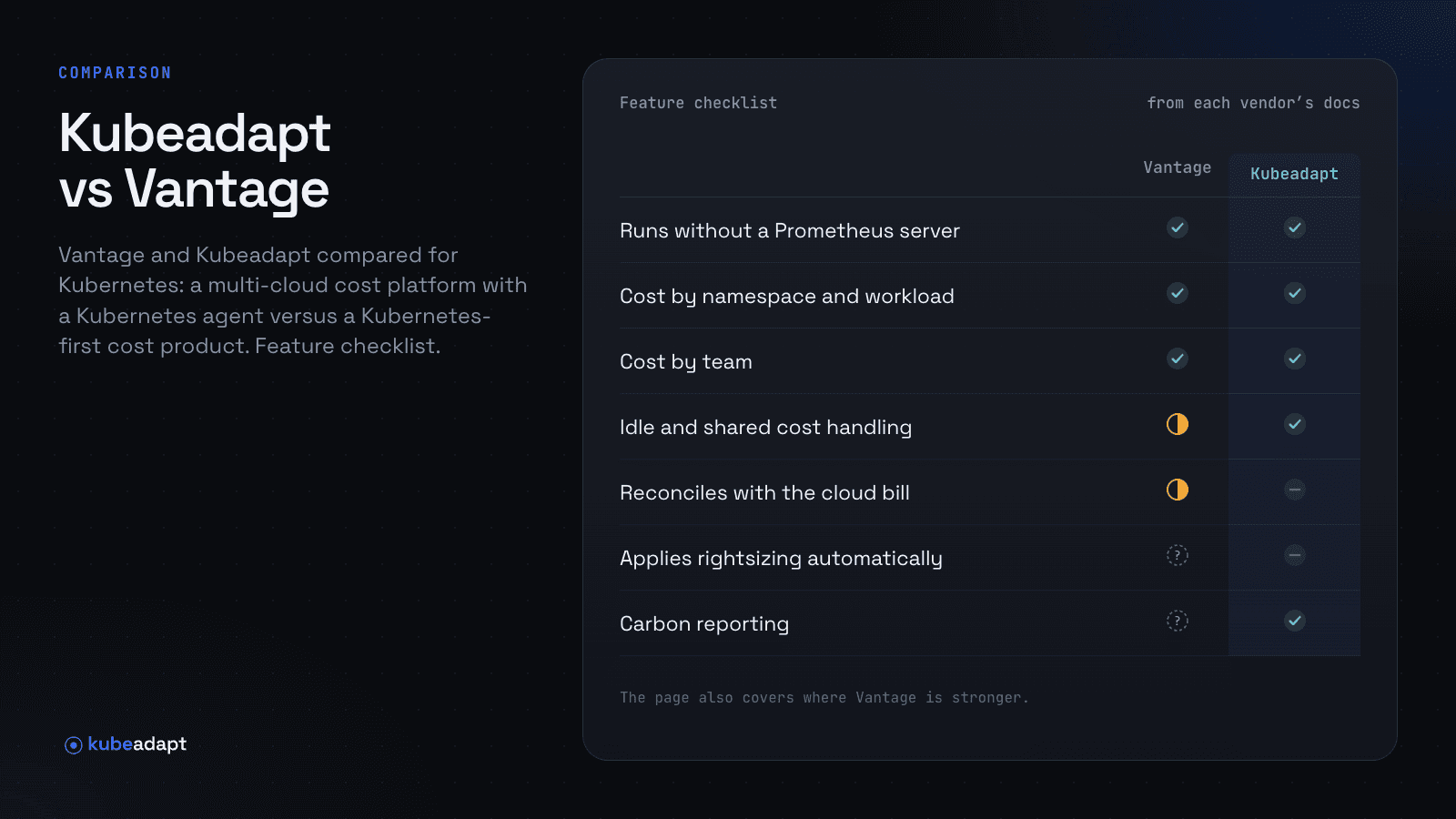
Each row was checked against Vantage's own documentation and Kubeadapt's docs on the review date. "Not documented" means we couldn't find it in Vantage's documentation; it doesn't mean the feature is missing.
| Vantage | Kubeadapt | |
|---|---|---|
| Runs as | SaaS with an agent in the cluster; optional network DaemonSet | Hosted SaaS in the EU; one agent per cluster, installed with Helm |
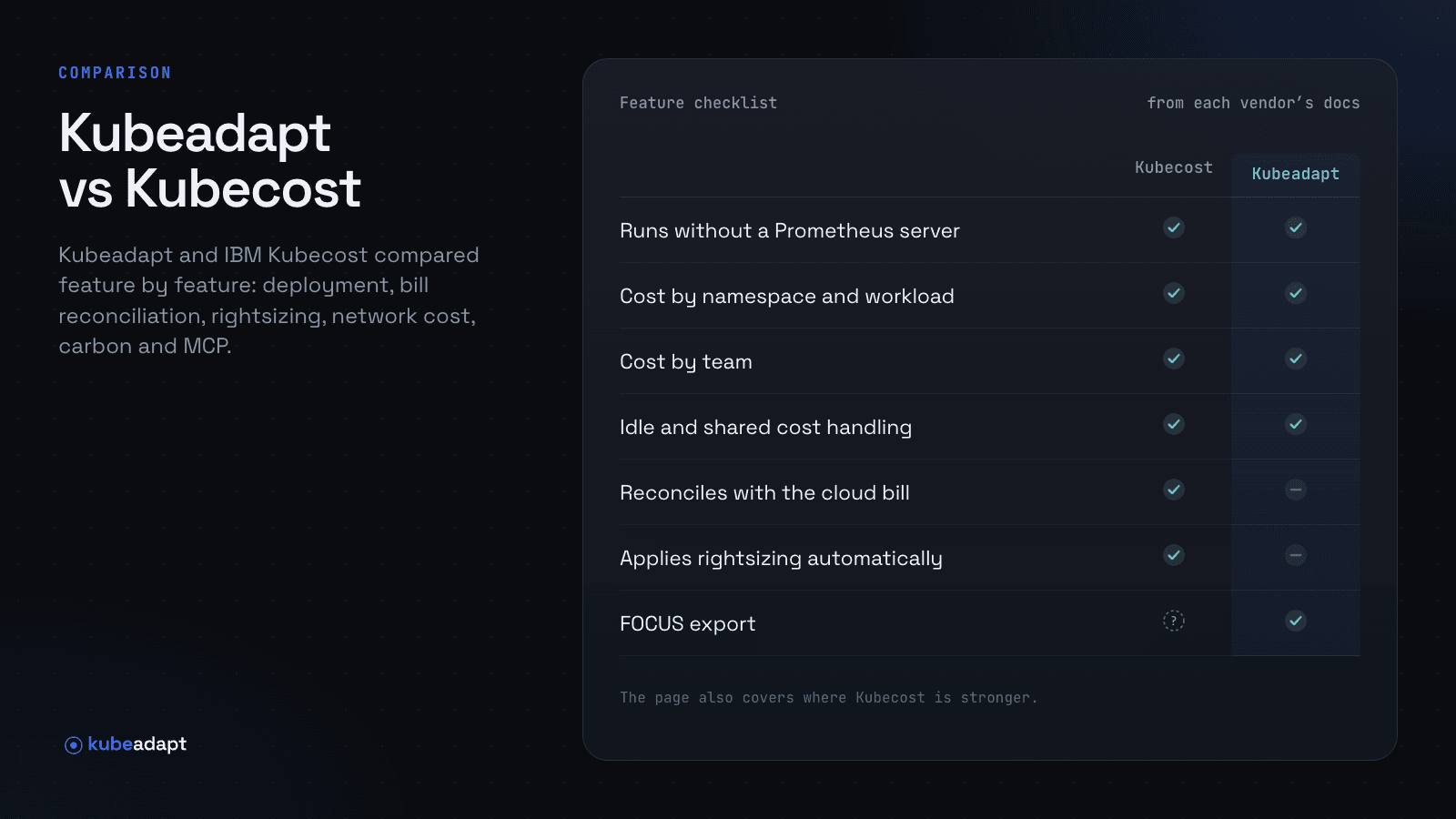
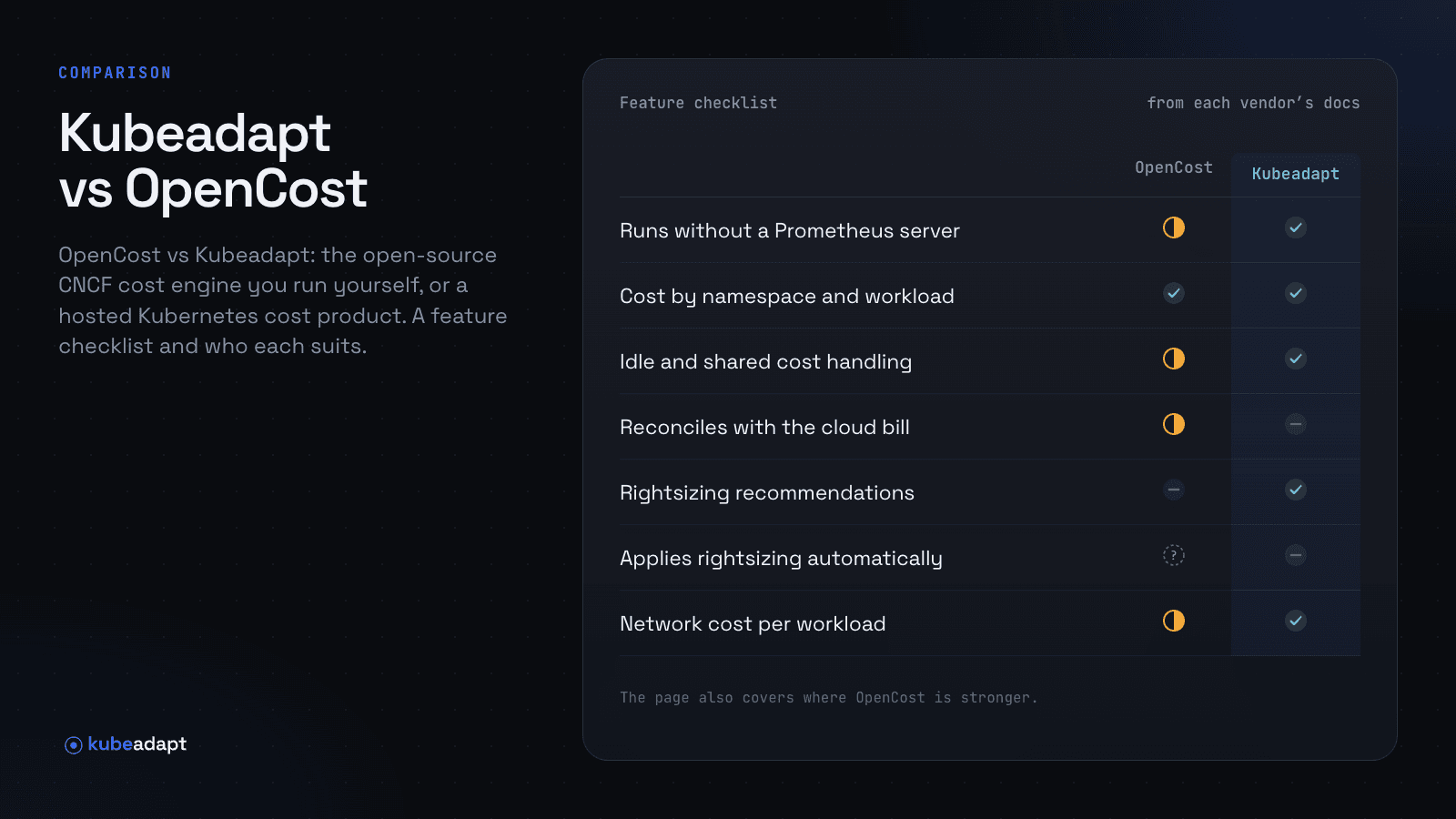
| Runs without a Prometheus server | Yesno Prometheus pods; reads the API server and kubelet | Yesone agent; metrics-server is needed for rightsizing |
| Cost by namespace and workload | Yescluster, namespace, service and labels (up to 10 labels) | Yescluster, namespace, workload, node, pod and container |
| Cost by team (labels or manual assignment) | Yeslabel grouping and virtual tags | Yeslabels or manual assignment; split across up to 10 teams |
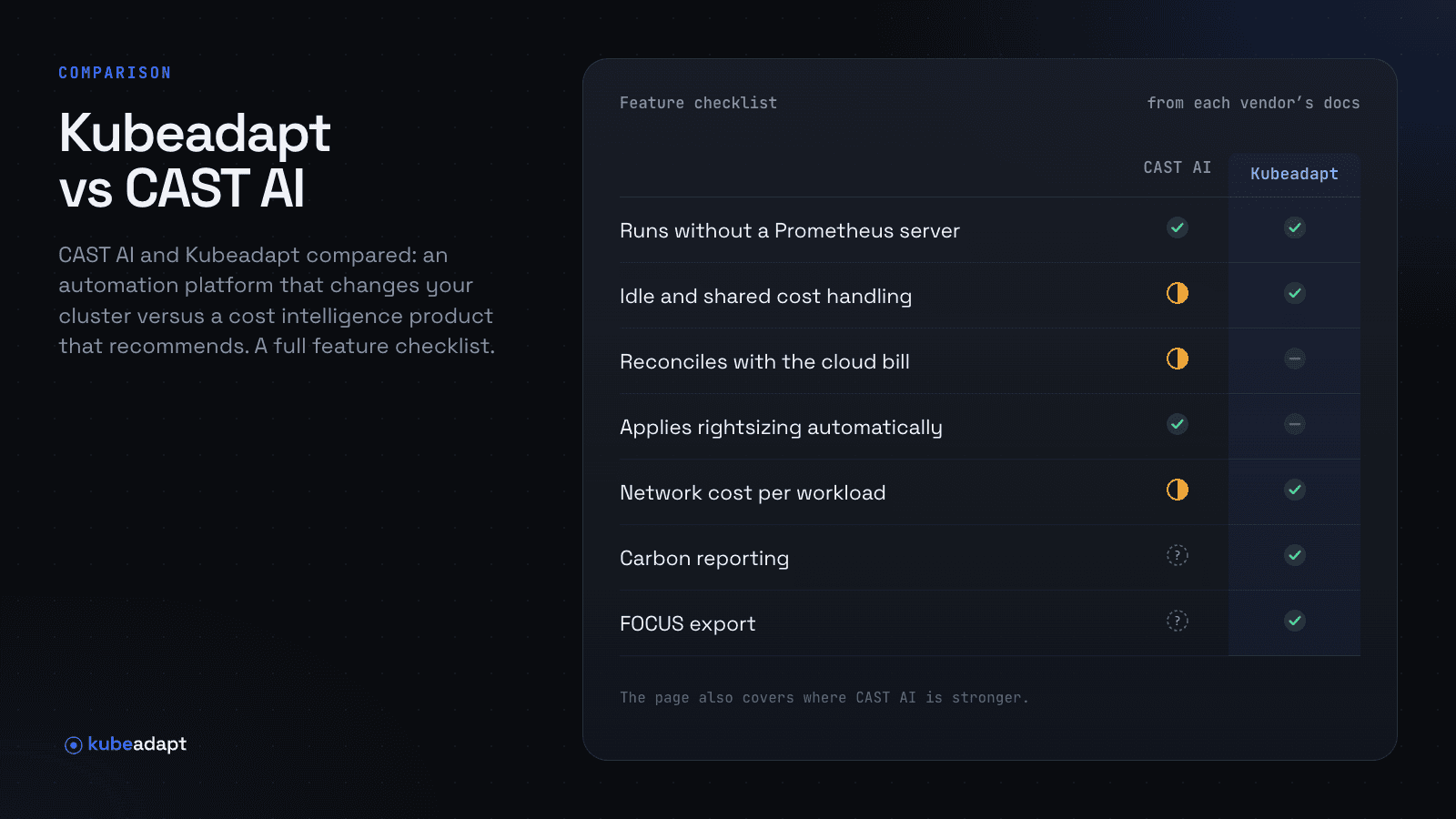
| Idle and shared cost handling | Partlyidle as its own namespace; shared-cost splitting not documented | YesFully Loaded (spread) or Workload Only views |
| Reconciles with the cloud bill | Partlynode cost from the cloud integration, but on-demand prices; discounts not reflected in Kubernetes reports | Nopublic prices, plus AWS Savings Plans and reservations from a connected account |
| Rightsizing recommendations | Yesper-workload CPU and memory recommendations | Yesrequests and limits per container, with a YAML patch |
| Applies rightsizing automatically | Not documented | Noby design; changes go through your own review |
| Node autoscaling or bin-packing | Not documented | Norecommends a node layout; doesn't change nodes |
| Spot instance automation | Not documented | Nospot-readiness score per workload; doesn't move workloads |
| Network cost per workload | Yesconntrack DaemonSet; not supported where the CNI bypasses netfilter (for example Cilium kube-proxy replacement) | YeseBPF at each pod's interface: cross-zone, NAT gateway and internet egress per workload |
| Carbon reporting | Not documented | YesCloud Carbon Footprint method; excludes embodied carbon |
| MCP server for AI tools | Yeshosted, OAuth or API token; reads and writes | Yeshosted, 23 read-only tools, OAuth sign-in with SSO |
| FOCUS export | YesFOCUS export across providers | YesFOCUS 1.4 as CSV or Parquet, or through the API |
Where Vantage is stronger
One view of everything. AWS, Azure, Google Cloud, Datadog, Snowflake, OpenAI and many more providers in one place, so Kubernetes sits next to the rest of the bill.
FOCUS across providers. Vantage exports and imports FOCUS for your whole cost dataset, not only Kubernetes.
Low-cost entry. A free tier and published monthly plans, with Kubernetes costs not counted against tracked spend.
Where Kubeadapt is stronger
Discounts in Kubernetes costs. Kubeadapt applies AWS Savings Plans and reservations from a connected account; Vantage's Kubernetes reports use on-demand prices.
Idle and shared cost, documented. Fully Loaded or Workload Only views, with every step documented.
Network attribution without conntrack. Measuring at each pod's interface with eBPF works where conntrack sees little traffic, such as clusters using Cilium's kube-proxy replacement. Kubeadapt's Network Intelligence prices cross-zone, NAT gateway and internet egress per workload.
Kubernetes depth. Rightsizing with limits and YAML patches, spot readiness, orphaned volumes, carbon per workload and a hosted MCP server built around Kubernetes questions.
Using both
Plenty of teams use a multi-cloud tool for the whole bill and a Kubernetes tool for what happens inside clusters. Kubeadapt's FOCUS export lets its workload-level costs land next to Vantage's provider data. Get started.