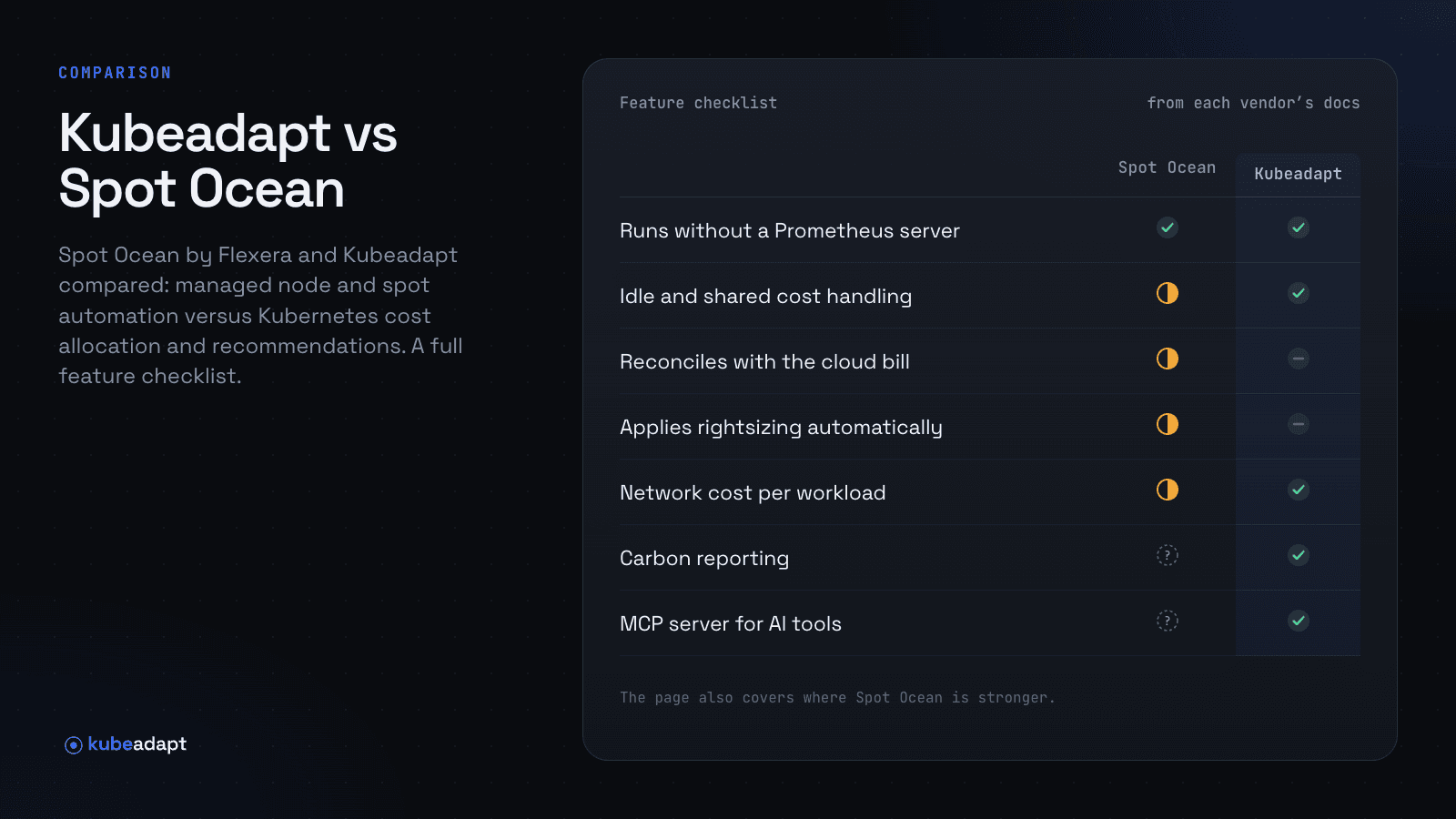
Spot Ocean is a managed data plane for Kubernetes and ECS. It replaces the cluster autoscaler, chooses instance types, blends spot, reserved and on-demand capacity, keeps headroom, and adds cost analysis and rightsizing on top. Spot.io was bought by NetApp in 2020, and Flexera completed its acquisition of NetApp's Spot portfolio in March 2025. Kubeadapt works one layer up: it measures and allocates cost and recommends changes, and leaves your nodes and autoscaler alone.
The short version
- Choose Spot Ocean if you want to hand node provisioning and spot strategy to a managed engine on AWS, Azure or Google Cloud, and your clusters can run on Ocean-managed nodes.
- Choose Kubeadapt if you want to keep your own autoscaler (Karpenter or Cluster Autoscaler), need usage-based allocation and showback across every node, or run on-premises clusters.
Feature checklist
Each row was checked against Spot Ocean's own documentation and Kubeadapt's docs on the review date. "Not documented" means we couldn't find it in Spot Ocean's documentation; it doesn't mean the feature is missing.
| Spot Ocean | Kubeadapt | |
|---|---|---|
| Runs as | SaaS plus the Ocean Controller in the cluster; Ocean manages the nodes | Hosted SaaS in the EU; one agent per cluster, installed with Helm |
| Runs without a Prometheus server | Yesuses metrics-server | Yesone agent; metrics-server is needed for rightsizing |
| Cost by namespace and workload | Yesnamespace and workload, for Ocean-managed nodes only | Yescluster, namespace, workload, node, pod and container |
| Cost by team (labels or manual assignment) | Yesbreakdown by labels and annotations | Yeslabels or manual assignment; split across up to 10 teams |
| Idle and shared cost handling | Partlyheadroom shown separately; root volumes and EFS split evenly | YesFully Loaded (spread) or Workload Only views |
| Reconciles with the cloud bill | Partlycosts from the capacity Ocean buys; no CUR reconciliation documented for Ocean alone | Nopublic prices, plus AWS Savings Plans and reservations from a connected account |
| Rightsizing recommendations | Yescontainer recommendations from 14 days of data | Yesrequests and limits per container, with a YAML patch |
| Applies rightsizing automatically | Partlyup to 10 workloads by default, more on request; in-place on Kubernetes 1.33+ | Noby design; changes go through your own review |
| Node autoscaling or bin-packing | Yescore product: autoscaling, bin-packing and instance selection | Norecommends a node layout; doesn't change nodes |
| Spot instance automation | Yescore product: spot, reserved and on-demand blend | Nospot-readiness score per workload; doesn't move workloads |
| Network cost per workload | PartlyeBPF network client; AWS and AKS only (no GKE) | YeseBPF at each pod's interface: cross-zone, NAT gateway and internet egress per workload |
| Carbon reporting | Not documented | YesCloud Carbon Footprint method; excludes embodied carbon |
| MCP server for AI tools | Not documenteda Flexera One MCP server exists; Ocean coverage not documented | Yeshosted, 23 read-only tools, OAuth sign-in with SSO |
| FOCUS export | Not documented | YesFOCUS 1.4 as CSV or Parquet, or through the API |
Where Spot Ocean is stronger
It runs your nodes. Instance selection, spot blending and bin-packing are Ocean's core, refined over many years. If node strategy is where your money goes, Ocean acts on it directly.
Spot at scale. Ocean manages interruptions, fallback and commitment usage for you, which is hard to build and run yourself.
Cost tied to what it bought. Because Ocean provisions the instances, its cost analysis reflects the actual spot, reserved and on-demand mix it chose.
Where Kubeadapt is stronger
Every node, any autoscaler. Kubeadapt allocates cost on every node in the cluster, including ones Ocean doesn't manage, and works with Karpenter, Cluster Autoscaler or fixed node groups. It also runs on-premises.
Usage-based showback. Each container pays the greater of its request and usage per minute, with teams from labels or manual assignment and finalized monthly reports. See cost allocation.
Recommendations without lock-in. Rightsizing patches and a spot-readiness score per workload that you apply yourself, with no controller to depend on.
Carbon, FOCUS and AI access. GreenOps reports, a FOCUS 1.4 export and a hosted MCP server with 23 read-only tools.
Using both
Ocean decides what nodes you run; Kubeadapt shows who used them and what it cost. Teams on Ocean can use Kubeadapt for showback and request rightsizing, which makes Ocean's bin-packing more effective. Get started.