Three different jobs hide behind "Kubernetes cost optimization", and most tools are built for one of them:
- Seeing the cost. Allocate the bill to workloads, namespaces and teams, and show where it changes.
- Deciding what to change. Recommend better requests, node types, spot usage and cleanup.
- Changing it automatically. Run a controller that resizes pods, replaces nodes or moves workloads to spot for you.
Knowing which job you're hiring for narrows the list quickly. Below is a checklist of fourteen products, then a short description of each, grouped by the job it does best. Every cell was checked against the vendor's own documentation on the review date above. Pricing and features change often, so confirm before you buy.
The checklist
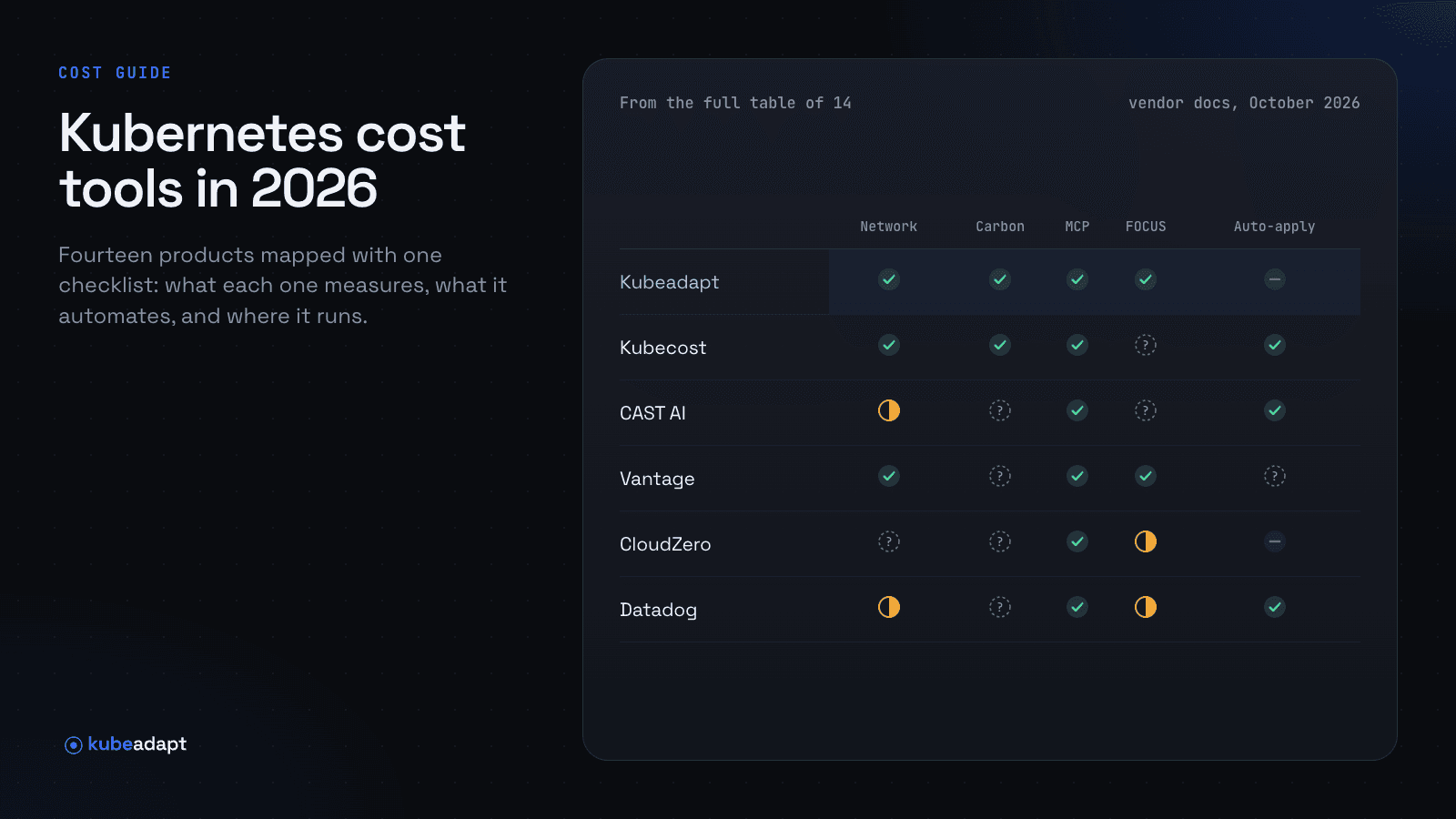
"Not documented" means we couldn't find the capability in the vendor's own documentation; it doesn't mean the product lacks it. Each product name links to a detailed comparison with every row explained.
| Product | Runs as | Bill reconciliation | Applies rightsizing | Node or spot automation | Network cost per workload | Carbon | MCP server | FOCUS export |
|---|---|---|---|---|---|---|---|---|
| Kubeadapt | SaaS (EU) | No | No | No | Yes | Yes | Yes | Yes |
| IBM Kubecost | Self-hosted or IBM cloud | Yes | Yes | Partly | Yes | Yes | Yes | Not documented |
| OpenCost | Self-hosted | Partly | Not documented | Not documented | Partly | Yes | Yes | Not documented |
| CAST AI | SaaS | Partly | Yes | Yes | Partly | Not documented | Yes | Not documented |
| Spot Ocean | SaaS | Partly | Partly | Yes | Partly | Not documented | Not documented | Not documented |
| PerfectScale | SaaS or self-hosted | Yes | Yes | Partly | Not documented | Yes | Partly | Not documented |
| ScaleOps | Self-hosted | Yes | Yes | Partly | Partly | Not documented | Yes | Not documented |
| StormForge | SaaS | Partly | Yes | Partly | Not documented | Not documented | Yes | Partly |
| Komodor | SaaS | No | Yes | Partly | Not documented | Not documented | Yes | Not documented |
| Vantage | SaaS | Partly | Not documented | Not documented | Yes | Not documented | Yes | Yes |
| CloudZero | SaaS | Yes | No | No | Not documented | Not documented | Yes | Partly |
| nOps | SaaS (EKS) | Yes | Partly | Partly | Not documented | Not documented | Yes | Partly |
| Datadog | SaaS | Yes | Yes | Partly | Partly | Not documented | Yes | Partly |
| Harness | SaaS | Partly | Not documented | Partly | Not documented | Not documented | Yes | Partly |
Seeing and allocating cost
- IBM Kubecost. The commercial product built on OpenCost, owned by IBM since September 2024.
- Runs: self-hosted, or as IBM's Enterprise Cloud.
- Covers: reconciliation with your cloud bills, scheduled request rightsizing, a conntrack-based network DaemonSet, carbon estimates, and a read-only MCP server in beta.
- Best for: teams that want a mature tool in their own infrastructure, especially on EKS, where AWS offers a free bundle.
- OpenCost. The CNCF's open-source allocation engine and specification (Incubating since October 2024).
- Runs: self-hosted, with Prometheus as the documented prerequisite.
- Covers: measurement, carbon and a built-in MCP server. It doesn't recommend or automate.
- Best for: teams that want a free, standard engine.
- Kubeadapt (us). A hosted product with one agent per cluster.
- Covers:
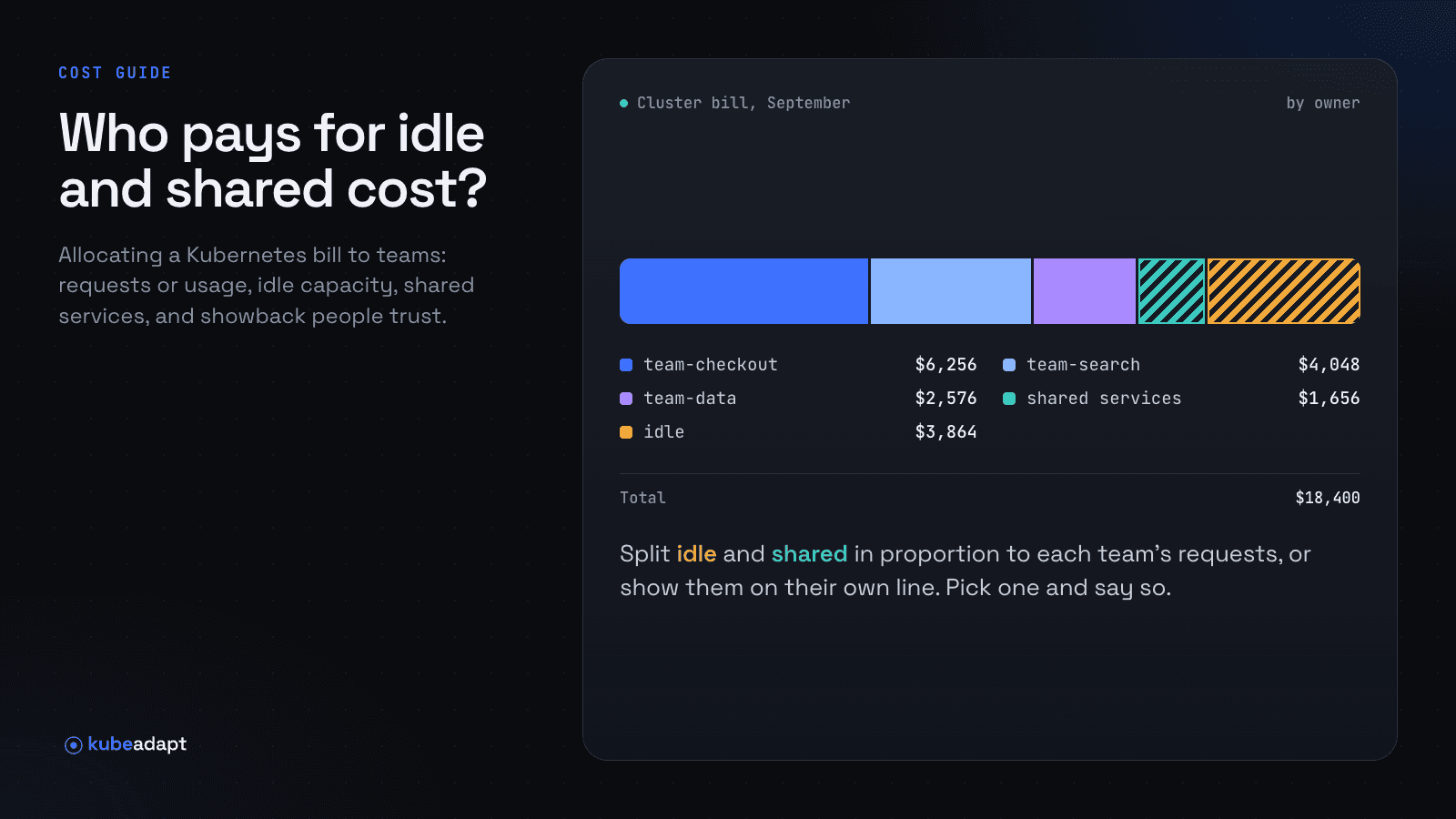
- per-minute allocation of every container, with team showback, idle and shared costs,
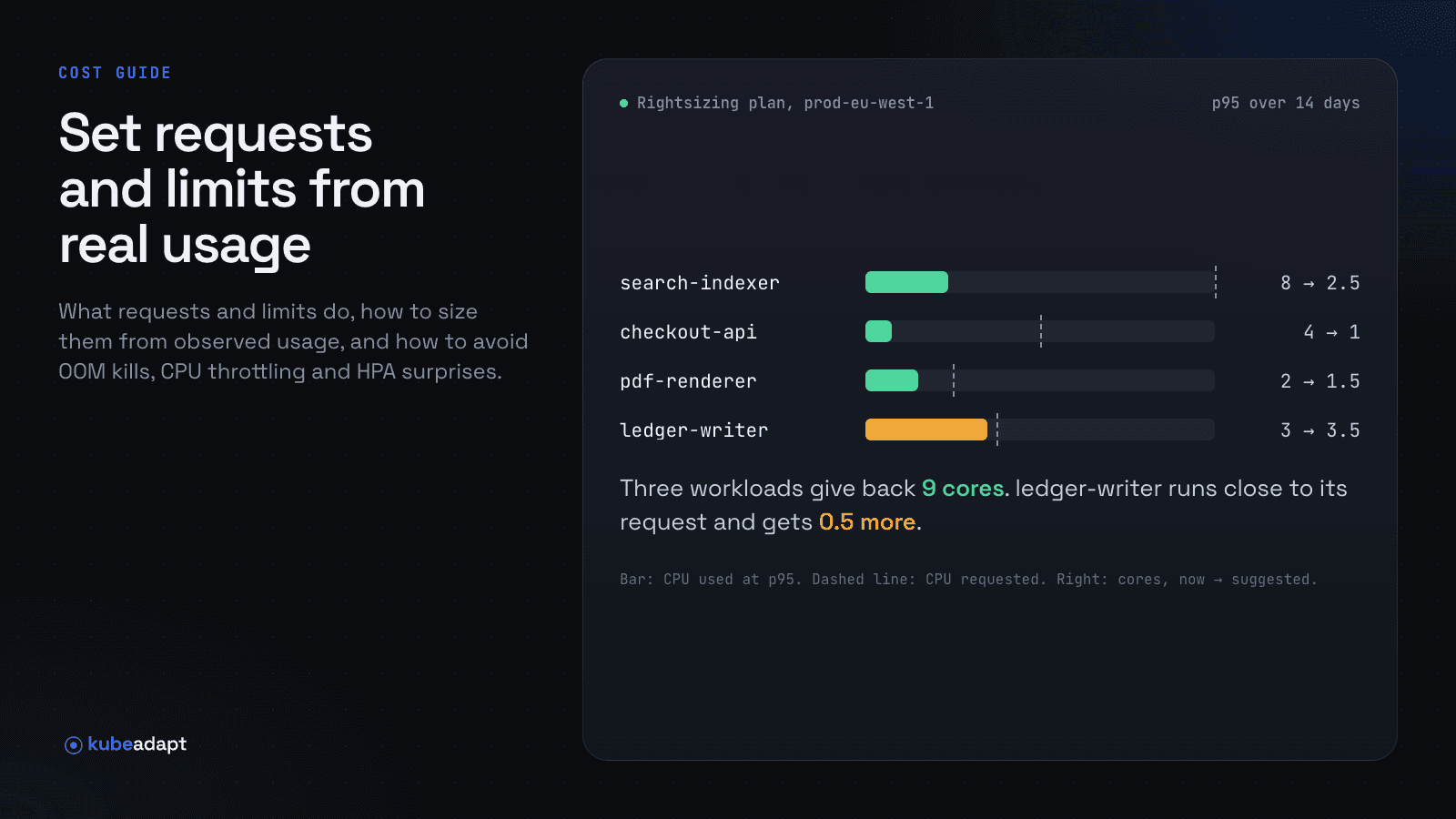
- rightsizing and spot recommendations that are never applied automatically,
- carbon reports and a FOCUS 1.4 export,
- a hosted MCP server,
- network cost per workload: cross-zone, NAT gateway and internet egress.
- Where it stops: it prices from public rates (plus AWS Savings Plans and reservations from a connected account) and doesn't reconcile with your invoice. It doesn't automate changes.
- Best for: teams that want answers and recommendations without operating a stack.
- Covers:
- Vantage. A cost platform for more than 30 cloud and SaaS providers, with a Kubernetes agent.
- Covers: conntrack-based network cost per pod, FOCUS export and an MCP server.
- Price: a free entry tier.
- Best for: organisations that want Kubernetes inside one view of all their spend.
- CloudZero. Unit-economics cost intelligence (cost per customer, product or feature), with Kubernetes costs built from your billed VM cost.
- Best for: finance-led organisations.
- Datadog Cloud Cost Management. Bill-based allocation joined to Datadog observability, with automated rightsizing through Datadog's autoscaling.
- Price: a percentage of cloud spend.
- Best for: teams standardised on Datadog.
- Harness Cloud Cost Management. Part of the Harness delivery platform.
- Covers: allocation, AutoStopping for idle environments, and early-access node and spot orchestration on EKS.
- Price: a free plan.
- Best for: Harness users.
- nOps. An AWS FinOps platform led by commitment management, with EKS cost from AWS's split cost allocation data.
- Note: its earlier EKS automation is no longer in its current documentation.
- Best for: AWS shops focused on commitments.
Automating changes
- CAST AI. Automated node autoscaling, bin-packing, spot management and in-place workload rightsizing.
- Price: free cost monitoring; automation by quote.
- Best for: teams that want a vendor controller to optimise continuously.
- Spot Ocean. Flexera's managed data plane that runs your nodes and blends spot, reserved and on-demand capacity.
- Best for: handing node strategy to a managed engine.
- ScaleOps. A self-hosted platform (air-gapped option) for continuous in-place pod rightsizing, node and spot placement.
- Best for: regulated environments that want autonomy inside the cluster.
- PerfectScale. Reliability-aware rightsizing with automation, a self-hosted option and a free tier up to 300 vCPU. Owned by DoiT since February 2025.
- StormForge. Machine-learned tuning of requests, limits and HPA targets, rolled out automatically. Part of CloudBolt since March 2025.
- Komodor. An operations and troubleshooting platform whose cost module rightsizes through an admission controller.
- Best for: existing Komodor users.
Open-source building blocks
- Karpenter. A node provisioner from AWS, now a Kubernetes SIG Autoscaling project with implementations for many providers. It provisions right-sized nodes for pending pods and removes unused ones. It doesn't allocate cost or size pods.
- Vertical Pod Autoscaler. Recommends and, in its update modes, applies container requests. It isn't part of core Kubernetes. Don't combine it with an HPA scaling on the same resources.
- Goldilocks. From Fairwinds. Runs VPA in recommendation mode for each workload and shows the suggested requests in a dashboard. A free starting point with no cost data.
How to choose
Answer four questions:
- Do you need numbers tied to the invoice? Choose a tool that reads your bill. Usage-based allocation from rates, like Kubeadapt or plain OpenCost, is accurate allocation, not reconciliation.
- Can cost data leave your infrastructure? If not, look at OpenCost, self-hosted Kubecost, ScaleOps or self-hosted PerfectScale.
- Do you want changes applied for you? If yes, look at CAST AI, Spot Ocean, ScaleOps, PerfectScale, StormForge or Datadog. If you'd rather keep every change in your own review process, choose a tool that recommends and stops there.
- Who will run it? A self-hosted engine is free in licence and costly in attention. A hosted product inverts that.
Most mature setups combine a measuring tool, an autoscaler such as Karpenter, and either a recommender or an automation product. To see where Kubeadapt fits, get started, or read our guides to cost monitoring and rightsizing.
Sources
- OpenCost documentation
- Apptio: IBM Kubecost
- Cast AI: Cost monitoring
- Flexera: Ocean cost analysis
- PerfectScale: Overview
- ScaleOps: Self-hosted platform
- StormForge: Architecture
- Komodor: Cost overview
- Vantage: Kubernetes
- CloudZero: Kubernetes
- nOps documentation index
- Datadog: Container cost allocation
- Harness: Kubernetes cost integration
- Karpenter on GitHub
- Kubernetes: Vertical Pod Autoscaling
- Goldilocks on GitHub